Classic Treatments
Advanced Treatments
Skin & Rejuvenation
Hair Removal

Body Treatment
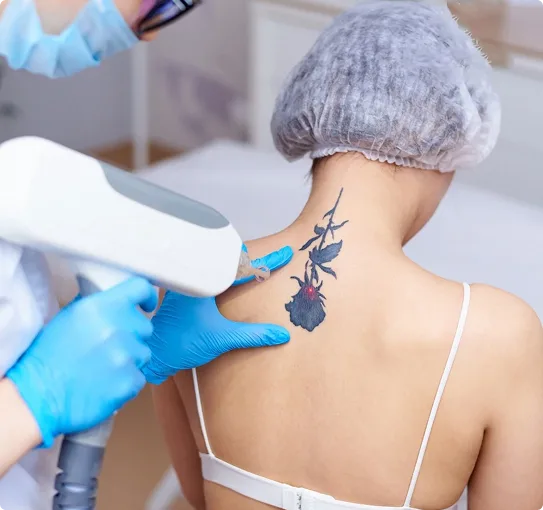
Laser tattoo removal uses concentrated pulses of light to break down the ink particles beneath your skin into fragments small enough for your immune system to clear naturally. It's the most effective method available, with results that build progressively across a course of sessions tailored to your tattoo and skin tone.
Book a Complimentary ConsultationDowntime: Minimal. Some redness, mild swelling or sensitivity in the treated area is normal and typically settles within a few days.
Session Time: Around 10 to 60 minutes depending on the size and complexity of the tattoo.
Treatment Plan: Multiple sessions are required, spaced 6 to 8 weeks apart to give your body time to clear the fragmented ink between treatments.
Important: Results vary significantly based on tattoo size, ink colours, ink density, age of the tattoo and your skin tone. A consultation will give you a realistic picture specific to your tattoo.
Not sure if tattoo removal is right for you? Get in touch and we'll help you figure it out.
What It Can Help With
Laser is the most clinically established method for tattoo removal. It's the only approach that targets ink beneath the skin without damaging the surface above it. Here's what it can address.
Unwanted Tattoos
Laser breaks down the ink particles sitting in the dermis, the deeper layer of skin where tattoo ink is permanently deposited, into fragments small enough for the body's immune system to identify and flush away over time.
Full Removal or Strategic Fading
Some clients want a tattoo gone entirely. Others want it faded enough to place new work over it. Laser treatment can be planned around either outcome, and your consultation will help determine what's realistic for your specific tattoo.
Black and Dark Ink
Black ink absorbs all laser wavelengths, making it the most reliably and efficiently treated. Dark blue and red inks also respond well to the right wavelengths. Green, yellow and some bright colours are more resistant and may require more sessions or a different approach.
All Tattoo Ages and Types
Laser treatment can be applied, whether the tattoo is fresh, years old, amateur or professionally done. Older tattoos and amateur work are often easier to clear because the ink sits closer to the surface and at lower density than professional work.
A Clean Slate
For many people, tattoo removal isn't about regret, it's about change. Whatever your reason, the goal is the same: skin that reflects where you are now, not where you were.
Face and Body Coverage
With four separate applicators of different sizes, BioNexis can be used on virtually every area of the face and body, including smaller areas like the arms and jawline that many body contouring devices can't reach.
The Treatment
Before the first session, we'll assess your tattoo's ink colours, age, density and your skin tone to give you a realistic, honest picture of what to expect, including how many sessions it's likely to take and what level of clearance is achievable. No guesswork, no surprises.
The fading doesn't happen in the session, it happens in the weeks after, as your immune system gradually removes the fragmented ink. This is why spacing sessions 6 to 8 weeks apart matters: it gives your body the time it needs to do the work before the next treatment begins.
Talk It Through With Becky1. Cleanse and prep
The treatment area is cleaned before the session begins. A topical numbing cream may be applied beforehand to keep the session comfortable throughout.
2. Laser treatment
The laser handpiece is passed precisely over the tattoo, delivering controlled pulses of energy to the ink beneath the skin. You'll likely notice an immediate whitish frosting on the tattoo surface. This is caused by rapid gas formation under the skin and is a normal, expected sign that the treatment is working. It settles within minutes. Most clients describe the sensation as a sharp snapping feeling, similar to a rubber band flick, with each pulse.
3. Cool and settle
Immediately after the session, a cooling or soothing product is applied to calm the skin and reduce any redness or swelling. The treated area may be covered with a light dressing.
4. Aftercare guidance
Before you leave, we'll walk you through exactly how to care for the treated area in the days that follow: what to apply, what to avoid, and what to expect as your body begins doing its part. How well you follow aftercare directly affects how cleanly the skin heals and how effectively the ink clears between sessions.
What to Know Before and After
Before Your Treatment
Avoid prolonged sun exposure, tanning beds and self-tanner for at least 2 weeks before your session, tanned skin significantly increases the risk of complications.
Come in with clean skin, free of creams, lotions or products on the tattoo and surrounding area.
Shave the treatment area if there is hair covering the tattoo.
Let us know at your consultation about any skin conditions, medications, history of keloid scarring or cold sore outbreaks.
Avoid blood-thinning medications and supplements unless medically necessary. Check with your doctor if unsure.
Avoid applying retinoids or active skincare to the treatment area for at least a week before your session.
After Your Treatment
Some redness, mild swelling and sensitivity are normal and typically settle within a few days.
Blistering may occur, this is a normal healing response for some clients. Do not pop or pick blisters. Keep the area clean and covered if needed.
Apply a broad-spectrum SPF 30 or higher every day and avoid direct sun exposure in the treated area until it has fully healed.
Keep the area clean and moisturised with gentle, fragrance-free products.
Avoid intense heat including saunas, steam rooms and vigorous exercise for 24 to 48 hours.
Do not pick, scratch or scrub the treated area at any point during the healing period.
Don't Take Our Word For It.
Devon Murphy
October 23, 2021
I absolutely love FaBesthetics! From my first appointment with Becky I have felt comfortable, confident, and amazing. She is extremely knowledgeable and very easy to talk to. I have done laser hair removal treatments and most recently a Dermaplaning Facial. Everything is very clean and the environment is very relaxing and soothing! My skin feels absolutely amazing and clear and I actually have been able to leave the house without makeup, I haven't had the confidence to do that in over 20 years. I highly recommended Becky - she is absolutely amazing ❤️
Sarah Cohen
December, 2026
Best spa I've encountered, her lasers and facials actually show fabulous results unlike other places! She knows her stuff. And she makes you feel so comfortable, like an old pal. I can't get enough of going there; it's not only fun but I look better and better every treatment. Prices are totally competitive!
You Might Also Be Interested In
Depending on your concern, one of these might work well alongside BioNexis Body Sculpting or as an alternative worth considering.
The laser emits concentrated pulses of light that are absorbed by the tattoo ink beneath the skin. That energy shatters the ink particles into tiny fragments, and over the following weeks, your immune system identifies and clears them naturally. The fading you see between sessions is your body doing its part.
It depends on the tattoo. Amateur tattoos with lighter ink density often require fewer sessions. Professional tattoos with dense, layered ink, particularly multicoloured work, typically require more. Most tattoos need somewhere between 6 and 12 sessions, though some may need more. Your consultation will give you a realistic estimate for your specific tattoo.
After each session, your immune system needs several weeks to identify and flush the fragmented ink from the treated area. Spacing sessions too close together doesn't speed results, it prevents the full clearing from one session before starting the next, and can increase the risk of complications. 6 to 8 weeks between sessions is the standard clinical recommendation.
Black ink absorbs all laser wavelengths and responds most reliably and quickly. Dark blue and red also respond well. Green, yellow and some bright or mixed colours are more resistant and may need more sessions or a different approach. During your consultation, we'll give you an honest picture of how your specific colours are likely to respond.
Most clients describe a sharp snapping sensation, similar to a rubber band flick, with each pulse. The intensity varies depending on the area and your individual sensitivity. A topical numbing cream can be applied beforehand to help.
Minimal. Some redness, mild swelling and sensitivity are normal and settle within a few days. Blistering can occur in some clients, this is a normal healing response, not a complication. You can typically return to normal activities the same day, though you should avoid sun exposure and intense heat for 24 to 48 hours.
Many tattoos can be fully removed, but complete clearance isn't guaranteed for every tattoo. Factors like ink colour, density, depth and your skin tone all affect the outcome. Some tattoos fade significantly but leave a faint trace. Others clear entirely. During your consultation, we'll give you an honest, realistic assessment.
Laser settings are adjusted specifically for your skin tone at each session to minimise the risk of complications.
Laser tattoo removal is not recommended for clients who are pregnant, have active skin infections or open lesions in the treatment area, a history of keloid scarring, or those taking photosensitising medications. During your consultation, we'll go through your full skin and health history so we can confirm it's appropriate for you.
Book a consultation and we'll assess your skin to create a personalized plan that helps you reach your goals.
Book a Consultation80 South Lake Blvd, Suite 301 · Mahopac, NY 10541 · fab@fabestheticsny.com